


Is a Honda Hybrid Right for Me?
A practical guide from Ide Honda
Is a Honda hybrid right for me?
Your daily drive. Your budget. Your next Honda. Understand how a hybrid works, compare the fuel costs, and decide what matters to you.
The short version
Gas goes in. No plug required.
A conventional Honda hybrid combines a gasoline engine, electric motors and a high-voltage battery. The system manages the power sources as you drive. You fill up at a gas station and don’t need a home charger.
The system does the switching.
Electric drive, engine-driven generation and direct engine drive work together as conditions change. You don’t need to choose a power source for every situation.
Recover some energy.
Regenerative braking turns some of the vehicle’s motion into electricity for the battery. Conventional brakes remain part of the braking system.
Keep a familiar routine.
The CR-V and Civic hybrid examples here use regular unleaded gasoline. Follow the fuel requirements in the owner’s manual for the vehicle you choose.
Hybrid, plug-in hybrid or electric: what’s the difference?
Conventional hybrid: uses gasoline and electric power, with no external charging. That is the type covered by this guide.
Plug-in hybrid: can charge from an external source and has a larger battery intended for some electric driving before operating as a hybrid.
Battery-electric vehicle: runs on stored electricity and requires charging. Its shopping and charging considerations are different.
Start with your routine
The right choice depends on your drive.
Fuel economy is part of the decision. So are the purchase price, equipment, space and how the vehicle feels on a test drive.
A hybrid deserves a close look if…
- You want to reduce fuel use without adding charging to your routine.
- Your driving includes local errands, traffic or a mix of city and highway miles.
- You drive enough miles to make the fuel difference meaningful.
- You prefer the hybrid’s response and the features on its available trims.
Compare the gas model carefully if…
- A lower vehicle price is your main priority.
- You drive relatively few miles or plan to keep the vehicle for a short time.
- Most of your driving is on the highway—use the appropriate MPG figures.
- Cargo space, towing, tire backup or a particular feature changes your choice.
These are starting points, not a promise that either powertrain will cost less for every driver. Try the numbers for the actual vehicles you’re considering.
Hybrid fuel-cost comparison
Examples verified November 1, 2026
idehonda.com/is-a-honda-hybrid-right-for-me/
875 Panorama Trail S, Rochester, NY 14625
Sales: 585-586-2820
www.idehonda.com
Make the numbers yours
What could a hybrid save you in fuel?
Start with an example, then adjust the mileage, gas price, MPG and vehicle prices. The SUV example uses AWD because that is what we primarily sell at Ide Honda.
Your fuel-cost estimate
- Annual fuel savings with hybrid
- $313
- Gas vehicle · fuel per year
- $1,448
- Hybrid · fuel per year
- $1,135
- Monthly fuel savings
- $26
- Hybrid price minus gas price
- $2,480
- Time / miles for fuel savings to cover a higher vehicle price
- 7.9 years / 95,037 miles
- Fuel savings less vehicle price difference · selected period
- −$914
A negative selected-period result means the hybrid costs more on fuel and the vehicle-price difference over that period. A positive result favors the hybrid on those two items only.
Illustrative CR-V AWD comparison: 12,000 miles per year, $3.50 per gallon, 29 / 37 MPG, $36,600 / $39,080 vehicle prices and five years.
The figures shown use the example above. Enable JavaScript to change the inputs. You can print using your browser’s menu.
Fuel and vehicle-price comparison only. This is not a payment quote or a complete cost-of-ownership estimate. It excludes taxes, dealer fees, financing, insurance, maintenance, repairs, resale value, incentives and changes in fuel prices. It assumes the entered mileage and MPG stay constant. Monthly fuel savings are not a reduction in a loan or lease payment.
Read the example prices correctly. CR-V EX AWD: $36,600 TSRP; Sport Hybrid AWD: $39,080 TSRP, each including $1,550 destination. Civic Sedan Sport FWD: $28,290 TSRP; Sport Hybrid FWD: $30,990 TSRP, each including $1,295 destination. Equipment differs within each pair; the price gap is not the cost of the hybrid system alone. Suggested prices exclude taxes, title, license, registration, dealer documentation fees, options, accessories and premium paint. A specific vehicle’s selling price can differ.
EPA ratings are for comparison. Actual mileage varies with driving, weather, maintenance, battery condition and other factors. CR-V preset: 27 city / 31 highway / 29 combined MPG gas; 40 / 34 / 37 hybrid. Civic Sedan preset: 31 / 39 / 34 gas; 50 / 47 / 49 hybrid.
How the calculator works
Annual fuel cost = annual miles ÷ MPG × dollars per gallon. Annual fuel savings = gas vehicle’s fuel cost − hybrid’s fuel cost.
When the hybrid has a higher vehicle price and positive fuel savings, estimated recovery time = that price difference ÷ annual fuel savings. Estimated miles = recovery time × annual miles.
The selected-period result = annual fuel savings × years − the hybrid’s vehicle price difference. There is no inflation, financing or resale calculation. Zero mileage, equal MPG or a hybrid with lower MPG can mean there is no fuel-based recovery of a higher price.
Around Rochester
Plan for the whole year.
A hybrid can fit a Rochester routine. Set realistic expectations for winter fuel economy, choose the right drivetrain, and give tires the attention they deserve.
Winter changes MPG.
Cold temperatures, warm-up, cabin heat and short trips can reduce fuel economy. Hybrids can see a larger percentage drop than gas-only vehicles. Don’t judge year-round savings by a warm-weather trip—or one cold week.
Hybrid doesn’t mean AWD.
Check the actual model and trim. The CR-V AWD examples here have all-wheel drive; the Civic Sedan examples are front-wheel drive. Fuel economy changes with drivetrain and trim.
Tires still matter.
AWD helps manage available traction. Appropriate tires, following distance and careful driving remain essential. Ask us about winter tires and seasonal storage.
Your hybrid options
Find your next Honda hybrid.
Explore the gas and hybrid choices in these guides, then compare the actual trims and vehicles. These are useful starting points within Honda’s hybrid lineup.
CR-V Hybrid
A five-seat SUV for customers who want cargo flexibility and an available AWD hybrid. Compare gas and hybrid space, towing and equipment in the guide.

Civic Sedan Hybrid
A compact sedan to consider for commuting and everyday driving. Compare gas and hybrid trims, features and cabin details.

Civic Hatchback Hybrid
Prefer a liftgate and flexible loading space? Compare the Hatchback’s gas and hybrid choices and see the seating and cargo layouts.
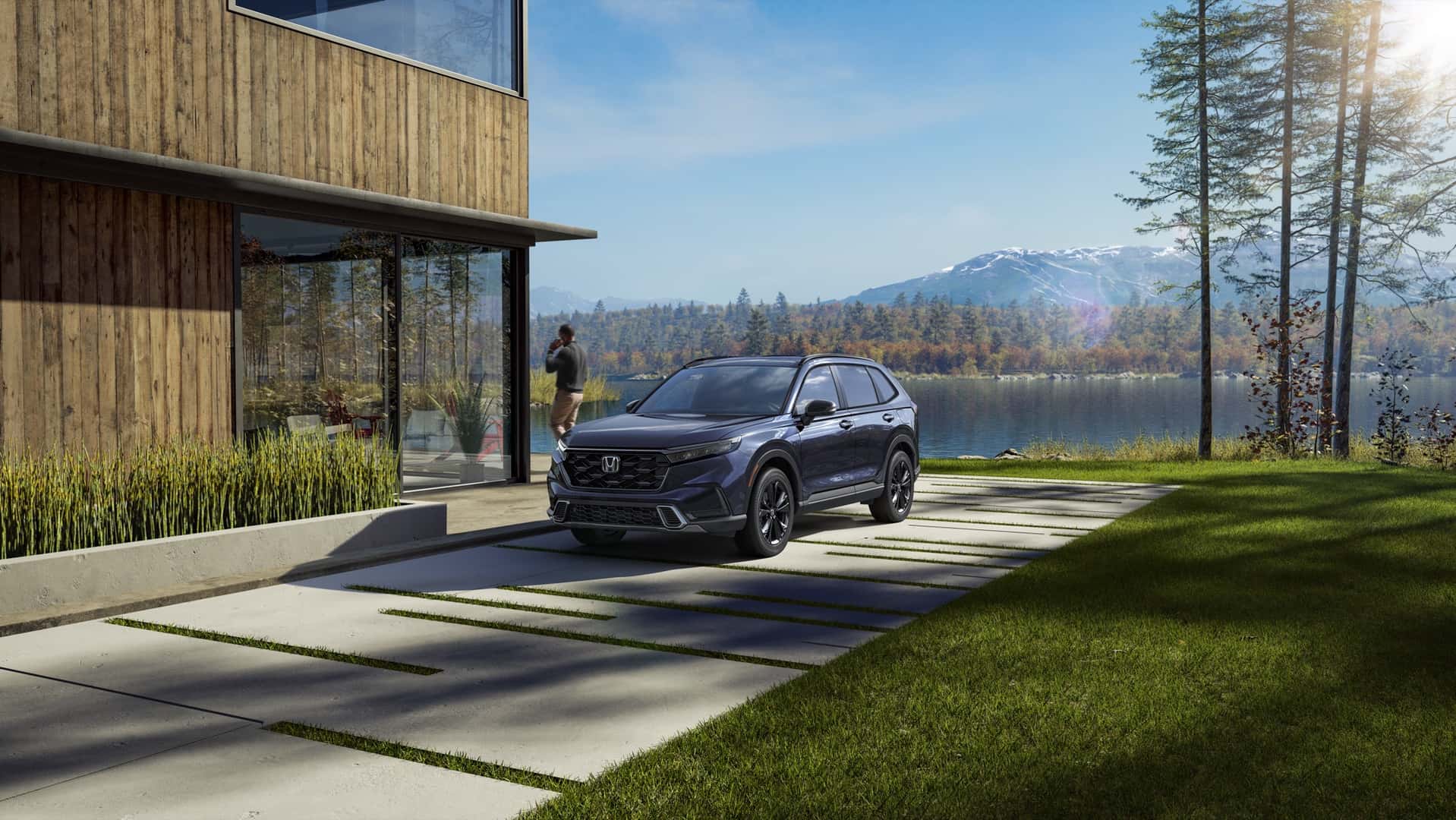
Photos are representative: 2026 CR-V and 2025 Civic models are shown. Trims, equipment and accessories vary by model year. Interested in a larger sedan? Explore Accord Hybrid inventory →
Bring this to your test drive
Five things to compare in person.
- Drive both powertrains. Compare response, controls and braking feel on a route similar to your everyday drive.
- Compare the actual equipment. Look at seats, comfort features, driver assistance and the drivetrain on each vehicle.
- Check your real cargo. Bring the stroller, sports gear or other items you regularly carry.
- Ask about ownership details. Review tire backup, maintenance and the applicable hybrid battery warranty.
- Work through your numbers. Use the actual selling prices and realistic MPG—not just a difference between advertised starting prices.
Guide: www.idehonda.com/is-a-honda-hybrid-right-for-me/ · Examples verified November 1, 2026. This worksheet is an estimate, not a vehicle price or payment quote.
Good questions. Clear answers.
Honda hybrid questions, answered.
Do I need to plug in a Honda hybrid?
No external charging is needed for the conventional Honda hybrids covered here. The engine and regenerative braking replenish the high-voltage battery as you drive. You still need gasoline.
Will a hybrid save me money if I mostly drive on the highway?
It may use less fuel, but compare highway MPG for the actual trims rather than applying city ratings to your commute. The 2027 CR-V EX AWD is rated 31 highway MPG; Sport Hybrid AWD is rated 34. The price difference, annual miles and time you keep the vehicle still matter. You can enter those highway figures in the calculator.
Is every Honda hybrid all-wheel drive?
No. The CR-V offers AWD hybrid choices, but drivetrain availability varies by trim. The Civic Sedan examples in this guide are FWD. Confirm the drivetrain on the individual vehicle; the hybrid badge does not establish AWD.
Do Honda hybrids work in Rochester winters?
Cold weather can reduce fuel economy in both gas and hybrid vehicles. Engine warm-up, cabin heating and short trips affect the result. A winter MPG drop does not by itself indicate a fault; persistent concerns should be checked. Compare realistic year-round driving and choose suitable tires for the conditions.
Does a Honda hybrid need premium gasoline?
The CR-V and Civic hybrid examples here specify regular unleaded gasoline. Use the fuel grade and other fuel requirements listed in the owner’s manual for your particular vehicle. Do not assume that requirements for one Honda apply to every model.
Does the engine turning on mean the hybrid is not working?
The gasoline engine is part of normal hybrid operation. It may run to generate electricity, provide propulsion or meet other operating needs. Electric-only operation depends on conditions; it is not an electric driving range that you select or a guarantee that the engine stays off.
Does a hybrid still need oil changes and regular service?
Yes. It still has a gasoline engine, tires, fluids, filters and conventional brakes. Follow the Maintenance Minder, owner’s manual and applicable time requirements. Regenerative braking does not eliminate brake inspections or service. Our Maintenance Minder guide can help you interpret common service codes.
How is the hybrid battery covered?
The high-voltage hybrid battery is separate from the 12-volt battery. Applicable coverage depends on the model, model year and warranty terms, including relevant emissions coverage. Ask Ide Honda to check the warranty booklet and coverage for the specific vehicle. A warranty period is not a prediction of battery lifespan.
Can I drive on gasoline alone if the hybrid battery has a problem?
Do not assume the hybrid system has a gasoline-only backup mode that makes a fault safe to ignore. Follow the warning message and the instructions in the vehicle’s owner’s manual, and contact service for the next step.
Is cargo space, towing or the spare tire the same as the gas model?
Check each item for the specific model and trim. In the CR-V lineup, gas and hybrid versions differ in published cargo capacity, towing limits and tire-backup equipment. Our CR-V guide compares those details. Bring your regular cargo and tell our team about any trailer before choosing.
Why doesn’t the calculator compare the cheapest gas trim with the cheapest hybrid?
The default CR-V comparison uses EX AWD and Sport Hybrid AWD to provide a more useful starting point than the base gas trim. They still have different equipment. The TSRP difference is not a stand-alone hybrid-system charge. Enter the prices of the actual vehicles you are considering for a personal comparison.
Does the calculator include financing, taxes or resale value?
No. It compares fuel cost and the entered vehicle-price difference only. It excludes financing, tax, fees, insurance, maintenance, repairs, incentives and resale value. It cannot predict a monthly payment or guarantee what ownership will cost. Review the full transaction with our team.
Should I choose the hybrid even if fuel savings take a long time to cover the price difference?
That depends on what you value. Compare the driving experience, equipment, space and the actual purchase terms as well as fuel costs. A gas model may fit your budget better; a hybrid may offer the combination you prefer. The calculator gives you one part of that decision, not a verdict.
Let’s compare what works for you.
Bring your questions and your usual driving routine. We’ll help you compare the vehicles and the numbers.
We’d love to earn your business.
Sources, example dates & important details
U.S. model examples verified November 1, 2026. Model-year details can change; confirm equipment, pricing and warranty coverage for the specific vehicle.
- Honda: hybrid and electrification overview
- 2027 CR-V pricing and EPA ratings · September 9, 2026
- 2027 Civic pricing and EPA ratings · October 8, 2026
- 2027 CR-V specifications and fuel recommendation
- 2026 CR-V Hybrid owner’s manual: hybrid system operation
- 2026 CR-V Hybrid owner’s manual: braking system
- 2026 CR-V Hybrid owner’s manual: Maintenance Minder
- 2026 Honda warranty booklet · check the booklet for your model year
- U.S. Department of Energy: cold temperatures and fuel economy
The 2026 owner-manual references explain general hybrid operation and maintenance. Use the owner’s manual and warranty booklet for your own model year and vehicle. No battery lifespan, maintenance savings, tax benefit or resale value is guaranteed.